Kristal Uribe-Cifuentes
[untitled]

Another bewildering thing I once heard my mother say:
Yo llegue a conocer la soledad desde el ‘99
I came to know solitude in ‘99, and have known it ever since
My mother, who to her own mother’s sorrow has lived abroad for the greater part of her adult life, is quite familiar with departures. She spent most of my childhood working in New York. She would come home every four, ve, sometimes six months. I don’t think she missed a single one of my birthdays, though I’m uncertain about Christmases. Resigned to the knowledge she would always have to take ight again, the moments I was able to spend with her were little more than a dream; they were the treasured reveries of my childhood. I become melancholy at the very thought of the years of hardship she endured all alone, the images of her life that have solidi ed as certainties in my mind despite being mere mirages, half speculative, half true: hundreds of scratch o phone cards, the sounds of dial tones, interference, call drops, coins falling into the vault of some payphone near an overhead train, strange people speaking in unintelligible or intelligible or only slightly intelligible languages near her, sometimes at her, the sounds of familiar voices, disembodied and distant, reduced to small windows of time; the feel of her body on the mattresses of cheap rented rooms with no kitchens, the taste of canned vienna sausages, chef Boyardee raviolis, the taste of food when you force yourself to eat with no appetite, having to wear thin coats in the dead of winter, bad shoes, dressing for a weather that is hard to get used to, that is hard to dress for, that is always changing but never at the time it is supposed to; the sight of tting her seasonal but somehow permanent life into small suitcases, an assortment of small reminders of home, a rag doll, a baby garment, pieces of jewelry she wore for several decades of her life, worn pocket photographs not of people but of love itself against the stark backgrounds of solitude, real solitude, not abstract or theoretical solitude, but inmense solitude, and her, in the center, in the middle of the precise silence of it all; the solitary gure of my mother taking the subway at dark hours of the night to save money on transportation, to save as much money as possible, to save every cent, to send every cent back home, to send every last cent that isn’t rent money; the gure of my mother on Mother’s Day, alone, dining alone, sitting at an otherwise empty table in an otherwise fully occupied restaurant, ordering lobster or crab or some seafood dish in an attempt to placate some brand of deep grief that I know exists in the body of the mother, maybe in the body of all mothers, but not being able to touch it, out of guilt for having ordered it in the rst place, and leaving. Year later, upon receiving her rst ever real paycheck in the US, a paycheck with her name on it, from a place that had legally employed her, she told me how nice it was to nally feel that she existed, that she, too, mattered: Uno siente que alfín existe, que uno cuenta.
These details, like a laundry list of disembodied experiences, have come to exist in my mind as fragments by virtue of the painful past they represent, a past I would never want to lose to oblivion, but that I sometimes wish I did not have to carry, though I know that such a wish trivializes my mother’s sacri ces to a considerable degree.
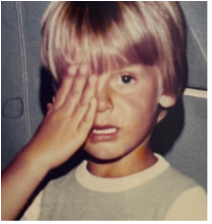
The earliest memory I have of my life is at my maternal grandmother’s house, in the neighborhood where I grew up, La Aurora. I am standing in the greenish living room at the front of the house, nearest the window, staring out at the orange owers that the low-lying tree or bush or plant on our terracotta tiled front yard gave, which I think was either an African tulip tree or a mountain immortelle. Or perhaps I am staring at the row of three Staghorn ferns that hang suspended on chains wrapped around the balustrade of the balcony across from us. Or at the two Christmas Orchids planted in clear plastic pots made from recycled sprite bottles. Ot at the Caladio potted in the doe shaped jardiniere at the center of the garden. Or at the Heliconas, or the Colombian Climbing Lilies, or the Anturios. Or the two-headed Quindio wax palm, tall and imposing, that every day casts its shadow over me. Or at its base, where an all-purpose aloe plant for home remedies and beauty rituals that cannot be trimmed, under any circumstance, at the height of the afternoon sun, has always lived. My right index and middle ngers are loosely rested against the right edge of my mouth. But I know that I am not looking at the owers so much as I am thinking about my mother, who had most likely recently departed—I feel anxiety typing departed here, it feels too much like the description of a death—, though I cannot know for sure. All I know is I feel sadness. And something buried very deep announces to me that the sadness was also a longing, and that I would carry with this longing for the rest of my life. My admiration and gratitude for my mother’s loving e orts to better my quality of life do not return this time to me, nor are they able to move me, ever so slightly, away from that window. Nothing can. And to know that my experience is by no means singular does not give me comfort as much as it does grief and, unfortunately, resentment, not toward her, but toward whatever exists out there, whatever it is people often refer to as God. From the thought of my mother’s solitude, and from the memory of her absence, I came to know distance, as well as the malleability, the multiplicity of forms, that solitude can take.
Chiara Zimmermann
[untitled]
A feeling which does not let me go until today, which always plops up, like a hick up, a feeling which is a sentence, which has never been said out loud, which my father never shared with us, that would still fill out every room of our homes, hidden behind the bright wallpaper with the soft green in it because of which Omi always squeezed her eyes, or quietly lying underneath the big carpet, everyone stamping over it. But I can see it. Like the hat in the belly of the snake, it catches my eye, hicks hicks:
hicks 1984 begegnete ich Einsamkeit hicks
hicks und seit dem lässt sie mich nicht mehr los hicks
After years of escalations and growing apart, my father finally moved out from his family home at age fifteen. The practice of departing became familiar, couchsurfing between small shared flats of acquaintances with mold on the walls. He started working in bars and clubs, and those places became his home. While crashing against the splitter glas holding some drink, he became a sculptor and with my first birthday he took over a small stonemason business. From then on most childhood memories of Papa are the sounds of the car leaving the driveway early in the morning and the car door slamming shut late at night when I was lying in my Hochbett, in a fight with my heavy eyelids, tying to keep them open. The remembrance of his heavy footsteps on the Wendeltreppe up to my room, the kiss on my cheek and eingemummelt werden, the blanket wrapped around me is faded, feels little more than a dream, makes me want curl again into the warmth of my cocoon. Melancholy means rain drops in your forehead, resting on your eyelids, becoming, again, heavy. This is how it feels when I imagine the years he was more on a search, for whatever, he might not even know himself, than feeling at home, being a(t) home; I see the mirror in the corridor, right at the entrance in the corridor, and I see his life in this mirror, the images blurry, sometimes sharp: the last check, brows knitted, when leaving, the work and the damaged back now, the short lashes because of the Fräse, the tiredness sitting deep, dropped down to the toes while trying to listen to our stories at the dining table, the bad reception of phone calls, the calls with the pocket of your jeans, the call that you will not make it to dinner, the phone that always rings, always always, ring ring ring; realizing that being the owner of a business means everyone talks about you but not with you; the taste of the first beer after everyone left the Hof, the taste of the 14th, the missing of my first school play in second grade, the missing of many more, the sitting on suitcases after buying presents for us, Wiedergutmachung, ; the empty body of my father walking in stores while on work trips, buying anything and nothing particular, trying to guess our taste, my favorite color at the moment, was it still blue?, or my brothers obsession with tractors or Asterix cards, looking to find something to bring home with, to show; a collection of small reminders of home, little photographs with abgenutzten ecken und risse over our faces, the smiles cracking in front of light blue background, the eyes shine, a angestrengtes smile, the eyes look at you more often from the photograph than in reality, and when you look at their shine hicks hicks; the figure of my Papa having Mittagstisch alone, sitting at an otherwise empty table in an otherwise fully occupied restaurant, ordering some seafood dish or way too much meat, breathing too fast in attempt to not hear, not feel the loneliness that I know exists in the body of the father, maybe in the body of all fathers, but not being able to touch it while taking big and fast bites of the tough meat, chewing chewing in attempt to being able to swallow, swallow it, swallow the feelings: Vielleicht hab ich Heimweh nach mir selbst.
The look in the familiar golden frame, welcoming you home and you don’t feel it you don’t see it, you don’t look at you.
Realizing that this feeling of mine, this experience is by no means singular, can be translated, maybe not easily in in a straightforward way but still, there they are, everywhere they are, does give me comfort and grief at the same time, not towards him but toward this whatever out there, responsible for my father’s solitude. And from my feeling of his absence, I came to know distance, and all of its chameleon character, the multiplicity of forms, that solitude can take.